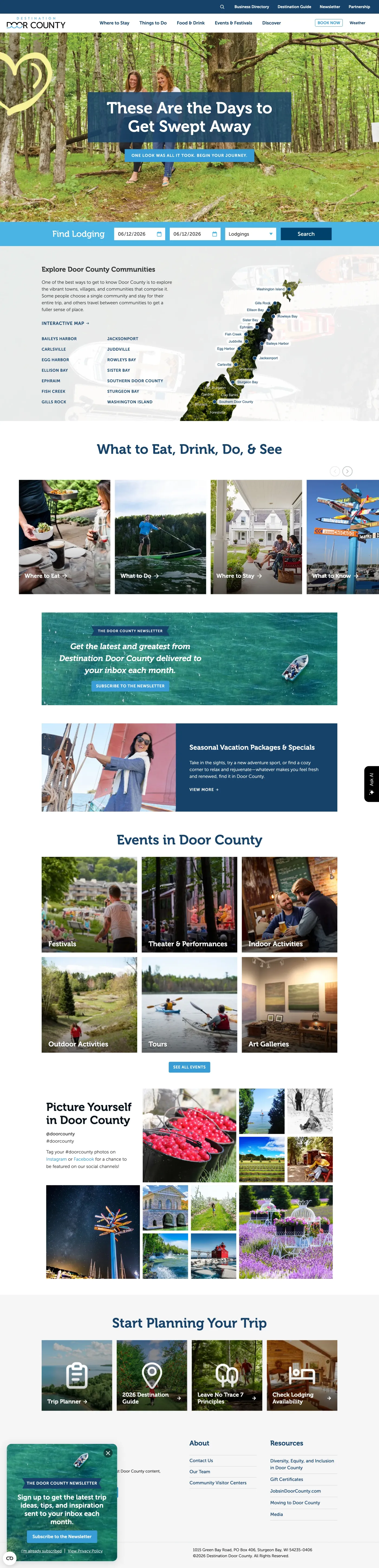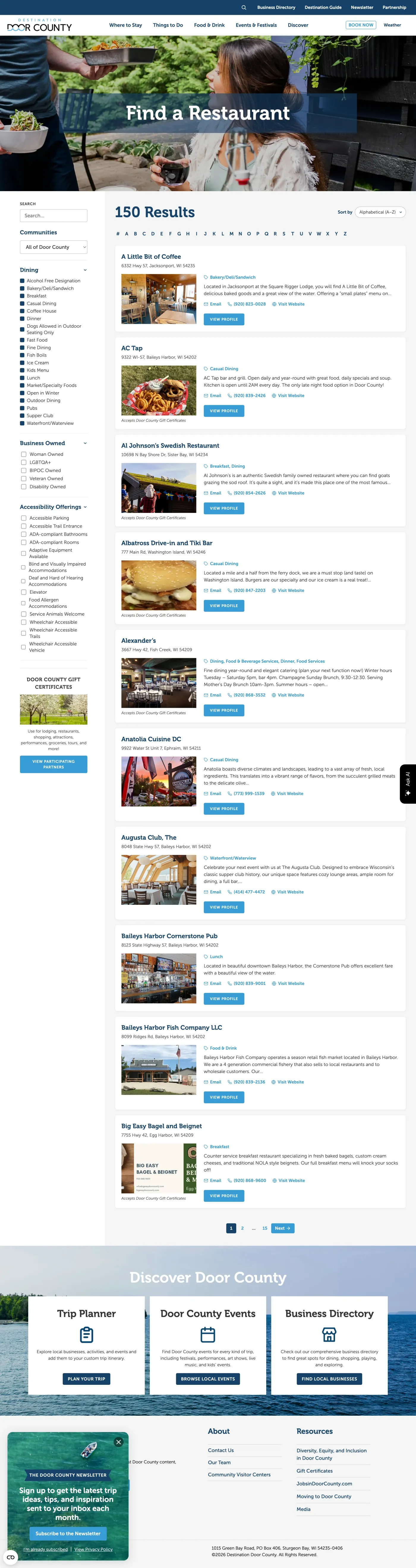
Door County is Wisconsin’s thumb into Lake Michigan — lighthouses, cherry orchards, kayak water, and a string of harbor towns from Sturgeon Bay up to Washington Island. Destination Door County’s site is a big one: a sprawling business directory, destination guides, events, lodging, and years of editorial content. This project was a complete rebuild of that site, moving it off the Kentico CMS and onto WordPress.
The interesting part wasn’t the front end — it was getting all of that content across.
The Challenge: a migration with no database.
A normal CMS migration starts with a database export. Here, I didn’t have one. I had limited source code and no database — just the existing site itself. A directory with 150+ business listings, communities, events, and a deep library of pages couldn’t be rebuilt by hand, and there was no clean table to import.
The Solution: an AI-assisted migration pipeline.
So I built one. I set up an intelligent pipeline that combined AI with scripting to fully bring the site over from Kentico to WordPress. The AI handled the messy, unstructured work — reading the existing content, classifying it by type, and extracting the right fields out of inconsistent markup — while scripting handled the high-volume templated content deterministically, transforming and importing it into clean WordPress structures at scale.
The result was a faithful, complete migration of a large content site that, on paper, had no straightforward path to migrate at all.
The Payoff: native block editing.
Just as importantly, everything landed in WordPress as content the Door County team could actually own. Instead of being locked into Kentico, their team now edits the site directly with the native Gutenberg block editor — building and updating pages themselves, no developer required. They were thrilled with the freedom, and it’s exactly the outcome a content-heavy destination site should have: a platform the people who run it can actually run.